Posts

Showing posts with the label 2020

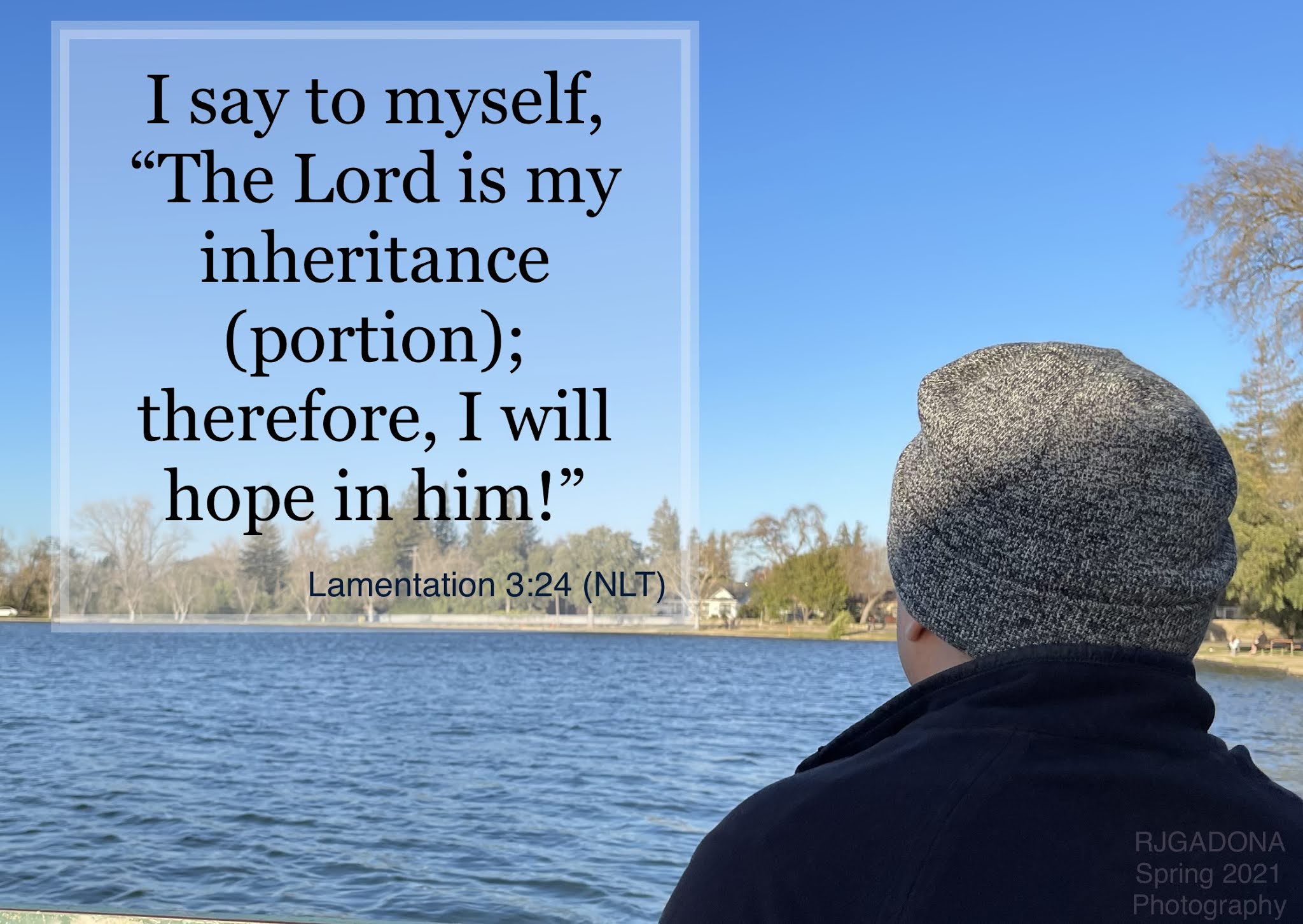
Jesus: The Believer’s Inheritance
Image
  It is fascinating to observe when people talk about inheritance, ones mind would immediately cater properties, wills, houses, jewelries, and other material things. All of which are centered on material temporal things.   In 1 Peter 1:4 , although The Apostle Peter used the term “inheritance” once in his letter, Apostle Paul on the other hand, mentioned this term in his letters several times. ( Eph_1:14 , Eph_1:18 , Eph_5:5 , Col_3:24 ,) But what is so significant about this particular emphasis of Peter? After all, he made a brief description of the inheritance (verse 4-5) a believer will obtain now that he is part of God’s family.   The term “inheritance” is not something new among Jewish ears. Going back to the OT, when God divided the promised land among the 12 tribes of Israel, every tribe received a portion of the land as their inheritance, except for the tribe of Levi…”the priestly tribe”. They were the only tribe that didn’t get one. God’s reason for doing so is i...


Christmas - More Than Just a Day

Image
  Christmas, the remembrance of that day when Jesus was born-- goes far beyond a day's celebration. From eternity past, God has ordained the virgin birth, the fulfillment of the coming of "Immanuel," God with us-- God incarnate.  "I bring you good news"-- this is the concept of "to evangelize." This good news "is so good because the bad news is so bad." What this "good news" should cause us to remember: The sovereign will and gracious act of God being displayed through Christ! See Eph. 1:4-6, Titus 3:4-7, and Rom. 5:8. He "chose us in Him before the foundation of the world, that we should be holy and blameless before Him."  The truth of God's Word-- He fulfills His promises in Christ! From Genesis to Malachi, God makes clear the prophecies concerning the Messiah; and, in Jesus, they are all fulfilled. See Luke 24:44-46.  The accomplishment of man's redemption through Christ! See 1 Cor. 15. This same Jesus will come...

Patiently Grumbling? - Notes on James 5:9-12

Image
After exhorting the oppressed believers to be patient until the coming of the Lord, James calls them next to "not complain against one another...so that [they] will not be judged." The root word for "complain" means to groan or to sigh, which in this context means much more than the mere disappointment expressed upon some inconvenience. This call to not grumble has to do with a problem stemming from a heart attitude that is not pleasing to the Lord, as it speaks of a heart that disregards the sovereignty of God and doubts His purposes.  Ponder on Philippians 4:10-13. There, as the apostle Paul himself had to LEARN to be content, it is evident that while still in the flesh, we have the tendency to grumble. By God's grace, though, we can learn like the apostle Paul "how to be brought low" and "how to abound in any and every circumstance." The same Spirit that enabled Paul is able to help us be content as we yield ourselves to His control.  Agai...

“Early and Latter Rain” - Notes on James 5:7-12

Image
In this passage, James changes gears from rebuking wealthy oppressors who live for their own wanton pleasure to exhorting his oppressed fellow believers to “be patient.” (On a side note, this passage is a timely message for us as we continue to face the effects of Covid-19, the rise of government restrictions, the movement towards loss of religious freedom, and the worsening of moral values in our society.) In view of the reality of trials in this life, James’ message is repeatedly addressed to fellow believers--“brothers and sisters.” As those who belong to Christ, we are told to be patient, which means that we are “not to lose heart.” Rather, we are “to bravely persevere in enduring misfortunes, troubles, or ill treatment” until the coming of the Lord! The basis of James’ exhortation is the fact that Christ's coming is near. It is for certain. It is "at hand!"  As an illustration, James reminds of how "the farmer waits for the precious fruit of the earth, being pat...

Wickedly Wealthy? - Notes on James 5:1-6

Image
In this passage, James is addressing the materially wealthy. At what point, though, does one become rich? Or how much does one need to possess to be considered as one of those addressed here by James? It is safe to say, I think, that this passage can apply to each of us who have more than what we need and have extra left over to help another. (Indeed, compared to most of the population outside the United States, we are all relatively wealthy!) Question: Is it sinful to be wealthy materially? Clearly, the answer is no. Indeed, we have rich individuals recorded in Scripture who were godly. Included in this list are Abraham, Job, David, and Lydia.  The problem, then, is not in possessing wealth in itself, but in the focus that we give it or the affection that we set upon it. It is not a small matter when we consider the fact that God gives us this specific warning: "the love of money is the root of all evil" (1Timothy 6:6-10). Take the rich young ruler, for example, in Matthew 1...

The Sovereignty of the God who Hears-- Notes on Daniel 9:1-23

Image
  The book of Daniel is one that points to God's Sovereignty-- sovereignty not just over each individual but over every nation. Indeed, he is sovereign over all!  Daniel was just a young man when he was carried away as a prisoner by the Babylonians, the nation used by God to punish unrepentant Israel. His family background and characteristics are described in the first chapter: an Israelite "from the royal family and the nobility," a young man who was "handsome, showing aptitude for every kind of learning, well informed, quick to understand, and qualified to serve in the king’s palace."  Chapter nine of Daniel hones in on a specific time period-- the first year of Darius ' reign. Go back to chapter 5 and there we are told about how Darius received the kingdom after Belshazzar the Chaldean saw "the handwriting on the wall." In keeping with God's Word, God's judgement had come-- not just over Belshazzar but over the entire Baylonian empire. ...

“Nothing More, Nothing Less, Nothing Else” –Notes on James 4:13-17

    There’s a story about a grandfather who tried to give advice to his grandson. He said, “Johnny, “Fools are certain, wise men hesitate.” Johnny, in reply, asked, “Are you sure, Grandpa?” With unequivocal confidence, the grandfather answered, “Yes, I am absolutely certain.”       This rather amusing story provides a good backdrop to the warning in James 4:13-17.  In this passage, we see James calling out to those whose boasting is evil by virtue of their self-confidence. “Look here,” James says, “you who say, ‘Today or tomorrow we are going to a certain town and will stay there a year. We will do business there and make a profit’” (James 4:13 NLT).       First, let’s look at how James describes those who are so certain of themselves that they are pronounced guilty of such boastfulness: their mind is set to work (“we will go... and do business”); they have a targeted location (“to a certain town”); they have a p...

The Matter of Slander - Notes on James 4:11-12

Image
  The particular subject of James in James 1:36 and James 3:1-11 is the tongue. He again returns to this subject in James 4:11-12.  Based on our prior studies, it is clear that “what you say flows from what is in your heart” (Luke 6:45). In James’ imperative to “not slander one another,” the heart of the problem, as one has aptly put it, “is the problem of the heart.”  The term “slander” speaks of having the intent of defaming or of falsely accusing another. Note that in 1 Peter 2:12, the apostle Peter speaks of slander by unbelievers against believers, which is to be expected, since unbelievers speak from a heart that is fallen in Adam. In contrast, James, in 4:11-12, confronts believers who are slandering fellow believers. Ponder on Matthew 7:1-5, which calls for believers to not condemn fellow believers. Rather, believers should love one another, for “by this all people will know” that they belong to Christ (John 13:34-35). James reasons, quite aptly, that a believer o...

“No Laughing Matter” - Notes on James 4: 9-10

Image
 It is often the case that we encourage one another to rejoice. In the beginning of his letter, James explicitly exhorted the brethren to count it as joy when they meet various trials. Why, then, would the command be given in James 4:9-10 that the brethren “be wretched and mourn and weep” and to let their “laughter be turned to mourning” and their “joy to gloom?” * Think back of the sins addressed in James 2:1-13 (partiality), James 2:14-26 (faith without works), and James 4:1-5 (affinity to the world). It is in view of these sins that James is calling for them to be wretched, to mourn, and to weep. Indeed, despite the grace they have received, they have chosen to act treacherously. They were disloyal or faithless to their Savior and Lord. For this reason, it is only right that they should be miserable for having committed such sins.  With the same force, James commands them to let their “laughter be turned to mourning” and their “joy to gloom.” It is implied in these phrases ...

“Draw Near With a Pure Heart”— Notes on James 4:8

The recipients of James’ letter are repeatedly addressed as “my brethren.” In James 4:8, however, they are addressed as “you sinners” and “you double-minded,” and are explicitly commanded to “draw near to God,” “cleanse their hands” and to “purify their hearts.”  Why would James describe his “brethren” with words that would not be fitting of fellow believers? To answer the question, we must look back to what James has communicated beforehand. First, in James 1:5-8, he who lacks wisdom is told to “ask God who gives generously to all.” In this context, James describes the doubter who will not receive anything from the Lord because he is ““double-minded, unstable in all his ways.” Next, in James 1:26-27, he who thinks he is “religious” is addressed, for “if... he does not bridle his tongue but deceives his heart, this person’s religion is worthless.”  Finally, in James 2:14-26, a hypothetical is given to drive home a point that James makes explicit— that is, “Show me your faith a...

Message From Our Pastor

It is indeed an alarming scene as we observe the anxiousness of the people in response to the global pandemic that we now face. The fear of uncertainty, security and possible death, has driven almost everyone to unreasonable panic and restlessness. As God’s children, how do we respond to all of these things? What does God’s word tell us? In Philippians 4:4-9, God’s word reminds us not to be anxious for anything…but to be prayerful in everything with thanksgiving. And the peace that is granted only to His people will give calmness to our hearts and minds. Since we believe that God is sovereign, and that even from eternity past, He has already ordained everything that will come to pass throughout human history; we can rest assured that God knows exactly what is going on and that He is still in control of everything. This is the blessing of being a child of God. Our hope and confidence is never in this world nor the things of this world. Our rest, security, and hope are found ONLY in Chri...