Posts

Showing posts with the label Sermons

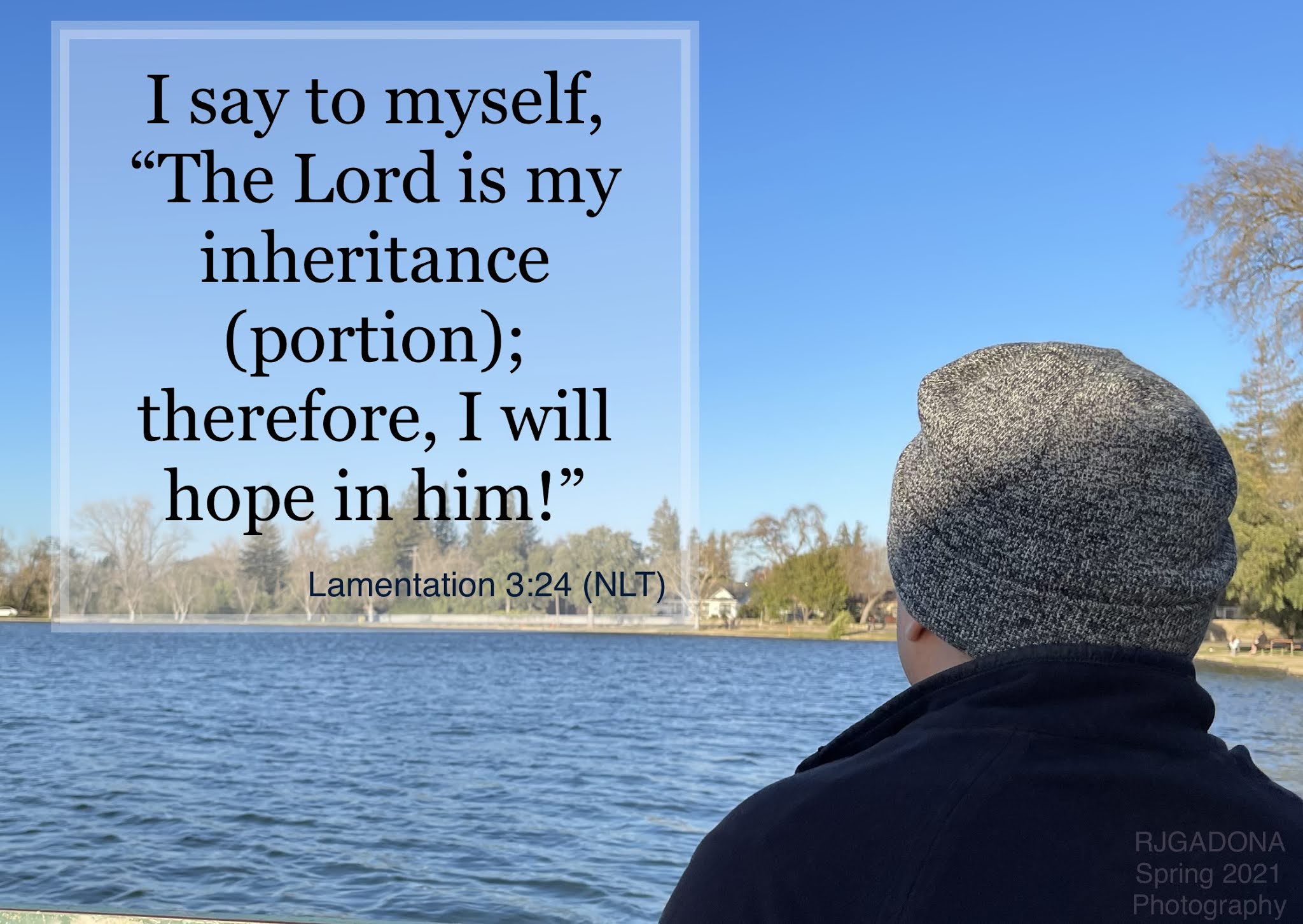
Jesus: The Believer’s Inheritance
Image
  It is fascinating to observe when people talk about inheritance, ones mind would immediately cater properties, wills, houses, jewelries, and other material things. All of which are centered on material temporal things.   In 1 Peter 1:4 , although The Apostle Peter used the term “inheritance” once in his letter, Apostle Paul on the other hand, mentioned this term in his letters several times. ( Eph_1:14 , Eph_1:18 , Eph_5:5 , Col_3:24 ,) But what is so significant about this particular emphasis of Peter? After all, he made a brief description of the inheritance (verse 4-5) a believer will obtain now that he is part of God’s family.   The term “inheritance” is not something new among Jewish ears. Going back to the OT, when God divided the promised land among the 12 tribes of Israel, every tribe received a portion of the land as their inheritance, except for the tribe of Levi…”the priestly tribe”. They were the only tribe that didn’t get one. God’s reason for doing so is i...

“Draw Near With a Pure Heart”— Notes on James 4:8

The recipients of James’ letter are repeatedly addressed as “my brethren.” In James 4:8, however, they are addressed as “you sinners” and “you double-minded,” and are explicitly commanded to “draw near to God,” “cleanse their hands” and to “purify their hearts.”  Why would James describe his “brethren” with words that would not be fitting of fellow believers? To answer the question, we must look back to what James has communicated beforehand. First, in James 1:5-8, he who lacks wisdom is told to “ask God who gives generously to all.” In this context, James describes the doubter who will not receive anything from the Lord because he is ““double-minded, unstable in all his ways.” Next, in James 1:26-27, he who thinks he is “religious” is addressed, for “if... he does not bridle his tongue but deceives his heart, this person’s religion is worthless.”  Finally, in James 2:14-26, a hypothetical is given to drive home a point that James makes explicit— that is, “Show me your faith a...

James 3:7-12 - The Test of the Tongue (contd.)

Context—James continues to make his argument about the tongue: James 3:7-8– “no human being can tame the tongue,” although every kind of animal (beast and bird, creeping things, and sea creatures) “can be tamed or has been tamed by mankind.” The point is this: while man is able to restrain beasts and every kind of creature, he is powerless to keep his own tongue under control. The tongue “is a restless evil, full of deadly poison.” To put simply, the sinful nature of man makes his tongue impossible to restrain. The tongue bears or brings death. It is deadly!  James 3:9-10– “From the same tongue come blessing and cursing.” Note the inconsistency and hypocrisy—with our tongue, “we bless our Lord” and with it “we curse people who are made in the likeness of God.” See Gen 1:26-27. How can we curse people when to do so would clearly be an insult to the One in whose image man has been created? James 3:11-12– “Does a spring pour forth from the same opening both fresh and salt water? Recal...

James 3:3-6 - The Test of the Tongue (contd.)

Context—James continues to make his argument about the tongue: James 3:3- a bit is a metal piece placed behind the teeth in the horse’s mouth connected to the reins, the purpose of which is communication and primarily, control. The whole body of the horse is guided by the use of such a little metal piece! James 3:4- a very small rudder guides or controls the direction of large ships! James 3:5- “So also the tongue is a small member, yet it boasts of great things. How great a forest is set ablaze by such a small fire.” James’ emphasis- The tongue is very  small but powerful in what it can do or cause! Consider again the analogies used:  1) A horse is very strong; yet, a small bit is enough to control its whole body! 2) A ship is a large vessel; yet, a small rudder controls its direction, wherever the will of the pilot directs! 3) A forest can be huge; yet, it can be set ablaze by just a small fire!  James 3:6- “The tongue is a fire, a world of unrighteousness.” Consider th...

James 3:1-3 - The Test of the Tongue

The tongue is one of the indicators of what is in the heart. See Luke 6:43-45, Mark 7:14-23, and Matt. 15:11-20. Consider Isaiah 6:1-7 where we see Isaiah’s response as he is exposed to the holiness of God. Isaiah uses the “tongue” as a measuring gauge for his sinful condition.  James, in chapter 3, elaborates further on what he has said before: “If anyone thinks he is religious and does not bridle his tongue but deceives his heart, this person’s religion is worthless” (James 1:26). James 3:1–“Not many of you should become teachers”— Is James discouraging believers from teaching? The answer must be “No,” especially in light of Heb. 5:12 and the Great Commission. James’ point may be better understood in view of Matt. 23. His point is that we ought to be careful and cautious in handling God’s Word. See 2 Timothy 2:15 and Rev 22:18-19. God’s Word should be taught accurately. Therefore, James reminds the believers to not be too quick to teach. James 3:2– “We all stumble in many ways”— ...

James 2:18-21 - A Living Faith

Review: (1) Salvation is by grace through faith in Christ alone; (2) Scripture must be understood in its context in order to avoid error; (3) James describes what a transformed life looks like— that is, that good works must necessarily result from genuine faith in Christ as Savior and Lord; (4) A mere profession of faith that shows no evidence of a life transformed is useless, as it is not genuine Verses in focus : James 2:18-21, which is to be understood in the context of the entire epistle James is here using another example in order to drive the same truth he has already proclaimed in the prior verses. See the explicit truth about salvation apart from works in Titus 3:5 and Eph. 2:8-10. In James’ example, a genuine believer is exposing the empty faith of one who is merely professing faith. The genuine believer is showing evidence of the true faith he possesses by the good works that is evident in his life: “I will show you my faith BY my works.” This genuine believer has a living f...

James 2:14-16 - Faith and Works

A. A proper interpretation of James’ message requires us to look at the recipient of James’ letter and its context, as this passage is used by some people to argue that faith alone cannot save— that is, “works” is a necessity for salvation. However, it becomes clear that James’ point is NOT that salvation is by faith PLUS works, but that GENUINE faith RESULTS in good works.  The RECIPIENT  of James’ epistle is “the brethren”— that is, those who are ALREADY saved! Therefore, James is not focused on HOW a person is saved, but how a person who is already saved should live out his salvation. The CONTEXT of James does not contradict the fact that salvation is by grace through faith alone in Christ, which is explicitly clear throughout Scripture, such as in Eph.2:8-10. James’ call is for the believers to pay attention to the need to demonstrate outwardly the transformation that they already have from within, which is made possible by grace through faith in Christ alone. B. If good w...

James 2:8-13 - The Unity of the Law and The Law-giver

In the prior verses, James points the believers to who God is: 1) He is Sovereign (none can boast of his standing before God, for it is only by the grace of God that one is saved, according to the kind intention of His will). In verses 8-13, James points the believers to the “royal law”—ie., if they are really “loving their neighbor” as themselves in “honoring the rich,” then they should also honor the poor in the same way, NOT showing partiality! By treating them differently based on their social status, they are actually “committing sin and are convicted by the law as transgressors.”  See Lev.19:18, where the royal law is emphasized on the basis of the One who gives it (“I am the LORD”). This command is quoted in several N.T. books (Mark 12:31-34. Rom. 13:9, Gal. 5:14, etc). See Deut 6:4-5. All that was written in the Torah and the Prophets is summarized in the two greatest commandments, as spoken by Christ in Matthew 22:34-40.  James points them to Nature of the Law and the...

James 2:5-7 - The Sin of Partiality Explained

Review from last week: If we show partiality, we commit sin.  Today’s message: James 2:5-7 James reminds the brethren of the Sovereign act of God in eternity past— “Has not God chosen those who are poor in the world to be rich in faith and heirs of the kingdom, which he has promised to those who love him?” (2:5). Read Ephesians 1:4-11, 1 Thess. 2:13, 2 Tim.1:9 with 1 Tim 2:4; 2 Pet.3:9, and John 3:16. Those in Christ have been chosen before the foundation of the world; yet salvation is offered to all.  James’ point is not that only the poor are saved or that the rich are condemned. His point is that a believer should not dishonor the poor man. Recall the account of the rich young ruler’s encounter with Christ. Jesus said that it is difficult (not impossible) for a rich man to enter the kingdom of God. The difficulty for the rich man is the temptation to  trust in his wealth; yet, the difficulty can be overcome. Recall the faith of Abraham, Job, and David, all who were wea...

James 2:2-4 - The Sin of Partiality Exemplified

Review: The transforming power of the Gospel is exhibited in the life of a genuine believer, who is called to show no partiality.  James provides an example, given in 2:1-4, through which we can understand the kind of partiality that believers should not exercise. A comparison is made between the rich and the poor, and the tendency to favor one over the other. Note the account that Jesus gives about the rich man and Lazarus. Clearly, the rich man was condemned not because of his wealth, nor was Lazarus saved on account of his poverty. Note also the account of the poor widow who is described by Jesus as having given more than those who gave out of their abundance. Finally, note Luke 18:18-27, where the rich young ruler asked Christ about how to inherit eternal life. Christ exposed the heart of the rich young ruler, who treasured material wealth above God.  A closer look at James’ example: During the “assembly” (“ecclesia” is not the word used here but one which refers to a gath...

James 2:1 - The Sin of Partiality

Review: During his ministry, Jesus had rebuked the Pharisees for their hypocrisy. They were religious but unrighteous. This inconsistency is what we are warned against in James 1:26-27. If we are followers of Christ, our walk should be consistent with our talk. Our lives should reflect the truth we have been taught and are called to faithfully proclaim.  A look at each phrase in James 2:1: “Do not hold” — ie., do not make it a habit or a way of living; “the faith of our Lord Jesus Christ”— ie, the body of truth, the Gospel message which is salvation through Christ alone; “who is glorious”— or “the Lord of glory,” an expression of the fact that Christ is the radiance of God the Father’s glory, the exact representation of his nature (See Heb. 1:3. Also, this points to Christ’s exalted position, being on the right hand of God. See Heb. 2:9); “with an attitude of personal favoritism—It is clear in verse 1 that James addresses “believers,” a witness to the fact that we as followers of C...

James 1:26-27 - Religious or Made Righteous?

Review: Believers are called to not be mere hearers of the Word, but doers of the Word.  This truth is further emphasized in James 1:26-27.  Note the contrast between “external performance” and “internal transformation” “If anyone thinks he is religious and does not bridle his tongue but deceives his heart, this person’s religion is worthless”— the term “religious” appears only here in James and the word “religion” (which appears elsewhere in Scripture) has a different root word than “religious.” In looking at sources outside of Scripture, the term “religious” can be defined as “rituals”. For example, one source speaks of Herodotus (5th Century B.C. Greek historian), with respect to his historical accounts, focused “mainly on the ritual and hardly on the belief underlying it.” Edwin Hatch, an English theologian in the 1800’s defined the term “religious” to refer to external observances of public worship such as church attendance, alms giving, prayer, and fasting.” Thus, one wh...

James 1:22-25 - A Hearer and a Doer of God’s Word

INTRO: Consider (and assess as to which group you belong)— There are those who cannot understand the Word of God, as they are blinded or are spiritually dead (See 1 Cor. 1:18, Eph 2:1-4, John 10:10, John 14:6) There are those who understand God’s Word but do not obey There are those who understand AND obey. The Call to Live Out God’s Word —Stay consistently obedient to God’s Word, even in the midst of trials and persecution.“Keep on becoming”- believers are to continue to apply the truth of God’s Word on a day to day basis— that is, to walk in wisdom! The Contrast between doers of the Word and hearers only (See Matthew 7:24-27). James uses the “mirror” to refer to God’s Word that allows us to “see” our condition. As a mirror allows us to see what our outward appearance looks like, the Word of God allows us to see what our inner appearance looks like. (1) The one who is a hearer only does nothing after he has “seen” what needs to be done, according to God’s Word. He neglects to practic...

James 1:19-21 - Quick to Hear, Slow to Speak, Slow to Anger

Recall the attributes of God— emphasized in last Sunday’s passage: 1) He does not change; 2) He is good; 3) He is Sovereign. James focused on the nature and ways of God. In today’s passage, James focuses on giving instructions as to practical Christian Living: “ Swift to hear ”= quick to listen, meaning to be always more willing to listen, to understand, to attend to, to consider what has been said, to comprehend what you hear. Recall the true story of when Jesus walked on the water— the disciples were terrified, thinking they saw a ghost. “They were utterly astounded, for they did not understand about the loaves, but their hearts were hardened.” This is an example of times that we hear and see but do not understand, when our hearts “are hardened.” Pray for understanding, to be ready always to listen to comprehend!  “ Slow to speak ”— (interesting note—the Guinness Book had recorded the world’s fastest talker to be able to articulate 586 words per minute—this record was broken in ...

James 1:16-18 - A Biblical Perspective

Introduction : God has given us the privilege of being His children (John 1:12). As his children, our faith is tested, that it might produce steadfastness for our maturity (James 1:2-4). With respect to temptations, each is “lured and enticed by his own desire,” for God himself “tempts no one” (1:13-14). This points us to the necessity for every believer to have an accurate knowledge of God, based on what He has revealed about himself from His Word, the Bible.  “ Do not be deceived ” (1:16)— to be “deceived” means to be led away from the truth or to be led into error, to be led away into sin. This points to what Satan does and who is, as revealed to us in God’s Word. He leads away from the truth into error. He appears as an angel of light (2 Cor. 11:14), even quoting Scripture (Luke 4:9-11), mixing truth with lies (truth, twisted, is not truth at all). He is the father of lies (John 8:44). He blinds the minds of the unbelievers (2 Cor 4:4).  In contrast to the Enemy who seeks ...

James 1:13-15 - God and Temptation

Review: During life’s troubles, the believer gets to enjoy the intimacy of his relationship with Christ as he receives His grace to persevere  “trials” and “temptations”— same root word, which means—to test, scrutinize, to examine, to try, to entice; but, these two terms, though appearing to be similar,  are not the same.  a) God allows “trials” for the purpose of proving, testing, and strengthening the quality of the believer—that is, his faith (James 1:3). Consider Abraham when he was tested by the command to offer his only son; Job, whose possessions were taken away; Joseph, who was sold by his own brothers; Daniel and his three friends, who were accused before the king. b) Each person is “tempted” when he is “enticed,” “dragged away,” “lured out” or “drawn away” (a picture of a bait for fishing); and, this luring away is “by his own desire.” Primarily, a man’s “temptation” comes from within! One’s desire from within, “when it has conceived gives birth to sin… and brings forth d...

James 1:12-15 - The Believer's Call to Persevere

Review: No one is exempt from trials. Whether poor or rich, each is to depend on and rest in the Lord.  Today’s Focus — James 1:12 A Call for Believers to Persevere — A compound word in the Greek, “to persevere” or to remain steadfast literally means “to stay under” or “to remain” (to not flee under misfortune or trials). Figuratively, it means “to undergo or to have fortitude, to abide, to endure, to patiently suffer or endure testing.” Consider the athlete, as an example, who keeps on, holding fast until he finishes. Thus, to persevere is to hold fast to one’s faith in Christ.  The one who remains steadfast under trial is “blessed” —same root word in Matthew 5 where Christ uses the word “blessed” repeatedly. Question: how can one be happy when one has to endure trials or ill treatment or perhaps injustice? Although It may be reasonable in our minds to rejoice in the context of a mother in labor or of an athlete nearing the finish line, to rejoice when suffering, humanly spea...

James 1:9-11 - Rejoicing Because of My Worth in Christ

Introduction: While James 1:2-8 appears not to connect with verses 9-11 (as there seems to be a change in the subject matter from “trials” to a contrast between pride and humility), we see that verse 12 continues with the subject of trials. There is, therefore, an actual connection— that is, whether one is poor or rich, both undergo trials!  What does the Bible teach about pride and humility? a) Pride is an abomination to the Lord. Pride is bound for destruction. See Prov. 8:13, 11:2, 16:5, 16:18; God is opposed to the proud but gives grace to the humble. Pride is evil. See James 4:6,16. b) Humility is to be the “clothing” of believers in Christ. With the humble is wisdom and God’s grace. The humble will be exalted. See Phil. 2:3-4, 1 Pet 5:5, Luke 14:11. The contrast in James 1:9-10 : The lowly brother (the believer who is poor or one who is of humble circumstances)  as opposed to the rich (the believer who is materially wealthy). Although some would view James’ reference t...

James 1:6-8 - Asking in Faith

Review: God knows our inadequacies; therefore, we are exhorted to ask NOT for a solution to our problems, NOT for the removal of trials, BUT to ask for wisdom IN the midst of trials. This emphasizes our need to be dependent upon God on a moment to moment basis, and the provision of wisdom by our God who is generous! Focus: James 1:6-8 The necessity of faith— “But let him ask [for wisdom] IN FAITH.” Heb 11:6- “And without faith it is impossible to please him, for whoever would draw near to God must believe that He exists and that He rewards those who seek him.” FAITH = “a conviction of the truth.” In Scripture, this is a conviction that pertains to a specific object—that is, Christ through whom all things were made, who was sent by God to be the Savior of the world. Thus, this faith referred to “is the believer’s unwavering confidence based on who God is and what He has done, according to the Scriptures.”  Knowing, then, that God does what He says, we trust and obey Him, for He is t...

James 1:5 - Living Wisely

Review- The believer can meet trials of various kinds with joy because he understands or knows the reason behind trials: 1) they produce steadfastness; 2) they mature us. Ponder on 2 Pet.1. A closer look at James 1:5 Not all believers are able to live wisely or are living wisely — this is indicated in verse 5a when James says, “IF any of you lack wisdom…” —The “wisdom” spoken of here is set in the context of daily life in relation to the trials that come. This “wisdom,” therefore, can be defined as “the proper application” of the proper knowledge and understanding of God and His will, as revealed in the Bible. “Right doctrine. Right living.” (It is important to acknowledge that we all experience a lack of wisdom, as was experienced by the disciples when they faced a storm at sea. They became anxious and fearful, although Jesus was with them on the boat! This leads us to the next important truth…. A believer’s deficiency can only be supplied by God— this is indicated in verse 5b when Ja...

James 1:2-4 - Consider It All Joy: Delighting in Difficulty - Part 2

Review: the universality of trials and the choice a believer has in facing trials James 1:3-5 The purpose for trials— they produce steadfastness!  This truth about trials is assumed to be a fact that genuine believers already “know”— Verse 2 says , “for you KNOW that the testing of your faith produces steadfastness.” This “knowing” speaks of having understanding, and is the same root word that speaks of the intimate knowledge between a husband and a wife (eg., he “knew” his wife). Therefore, as it is said in 1 Pet. 4:12, “do not be surprised at the fiery trial when it comes upon you to test you, as though something strange were happening to you.” In view of what we know about the purpose for trials, we then ask “what?” instead of “why?” (for we already know why trials come)—We can ask, for example, “Lord, what are you desiring for me to learn during this trial? Lord, what do you want me to do?” (See, for example, Acts 8:36, 16:30)  This purpose behind trials gives us the reaso...