Posts

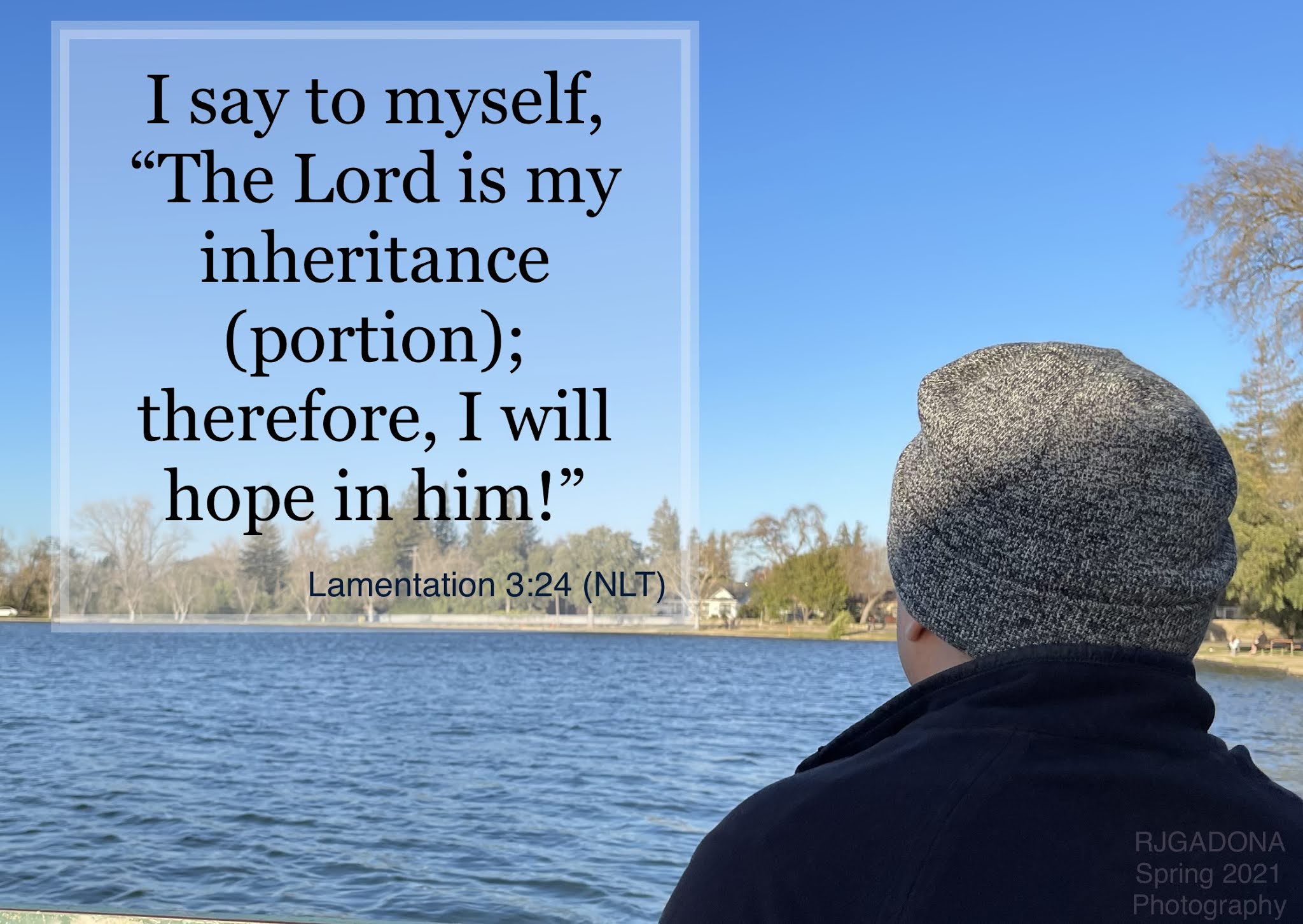
Jesus: The Believer’s Inheritance
Image
  It is fascinating to observe when people talk about inheritance, ones mind would immediately cater properties, wills, houses, jewelries, and other material things. All of which are centered on material temporal things.   In 1 Peter 1:4 , although The Apostle Peter used the term “inheritance” once in his letter, Apostle Paul on the other hand, mentioned this term in his letters several times. ( Eph_1:14 , Eph_1:18 , Eph_5:5 , Col_3:24 ,) But what is so significant about this particular emphasis of Peter? After all, he made a brief description of the inheritance (verse 4-5) a believer will obtain now that he is part of God’s family.   The term “inheritance” is not something new among Jewish ears. Going back to the OT, when God divided the promised land among the 12 tribes of Israel, every tribe received a portion of the land as their inheritance, except for the tribe of Levi…”the priestly tribe”. They were the only tribe that didn’t get one. God’s reason for doing so is i...

Ecclesiastes - Life is Meaningless apart from God

Image
“All is meaningless and there is nothing new under the sun” was the cry of  Qohelet  (the Preacher) in the book of Ecclesiastes. Though he pursued every sort of work, desire, knowledge and experience under the sun, his heart and soul remained empty. Though Bible scholars are divided as to whether Solomon or a post-exilic anonymous character authored the book, the message is clear: apart from God, all is vanity, ultimately useless and empty (Ecclesiastes 1:1-3). Qohelet  begins by stating the first part of his thesis in Ecclesiastes 1:1-3. The following chapters describe how and why he arrived at his conclusion. In brief,  Qohelet   endeavored to find meaning and purpose in life by engaging himself in pleasure, women, wine, personal projects, wealth and many more (ex. Ecclesiastes 2:1-11). His pursuits and accomplishments left him only frustrated and even more so when he shifted his attention to the perplexities of our imperfect world (ex. Ecclesiastes 4:1-7, 13-16; 5:8-17). Qohelet  wa...

The Resurrection of Christ

Image
The man most well known for the grievous trials he faced asked this question– “If a man dies, will he live again?” (Job 14:14 a). If answered from one’s own view or understanding, the response will vary (ranging from the belief in purgatory or rebirth or to the annihilation of the soul). One truth we can all agree on– death is no respecter of persons. It comes to everyone–the wise, the fool, the rich, the poor; and when it comes, it stings. The separation it creates between loved ones brings pain. It brings grief. While some may choose to end their own life, we can all agree that most people view death with fear or as a hateful enemy. How does the Bible respond to this worldview question? First, the Scriptures explain how death entered into the world. Genesis 3:17-19 and Romans 5:12 make clear that death is the result of man’s sin against God. However, according to the Scriptures, man’s death is not the end. In John 11, an account is given about a man...

Proverbs - "A Book on Wisdom"

Image
If the book of Psalms reveals the religious side of humankind, Proverbs reveals another human aspect that separates us from the rest of creation–the desire for knowledge. Without a doubt, man thirsts for understanding. In fact, his pursuit of knowledge has brought him to a point where he has forgotten its Source; he has become wise in his own conceit.   Proverbs begins with a clear statement of its purpose–that is, to give wisdom and instruction (Proverbs 1:2-6). It lays down the foundation for real knowledge—the fear of the Lord (Proverbs 1:7). The knowledge of God and His word is to gain true understanding and to obey Him is true wisdom. He who applies biblical truth in his life is wise (Read James 1).   Proverbs is a book of pithy sayings. It communicates truth and instruction for daily living. Among other things, it teaches us about human conduct (Proverbs 20:11); temper (Proverbs 29:11), pride (Proverbs 27:1) and laziness (Proverbs 13:4). It gives instruction ...

Psalms - "A Song Book of Praises to God"

Image
I am convinced that no other Old Testament book has received as much attention as the book of Psalms. Replete with life experiences with which many can identify, this book is often read and repeatedly quoted. Seventy-three of the 150 psalms were written by David. The rest were either written anonymously or by Moses, Solomon, Asaph, sons of Korah, Ethan or Heman. The book of Psalms is a songbook of praise to God. Among other things, it shows to us (1) God’s glory and sovereignty as seen in creation and His supremacy over the nations (an example is Psalm 19:1-2; Ps. 46); (2) the excellence of the Word of God (ex. Psalm 19:7-14; Ps. 119); (3) the characteristics of a godly man (ex. Psalm 42) and; (4) the Messianic King for which Israel longs (ex. Psalm 8; Ps. 22; Luke 24:44). Significantly, the book of Psalms reveals to us an aspect of our humanity that separates us from the rest of God’s creation– our longing for someone to worship (ex. Psalm 27:1-4; 84:10-11), someone t...

"The Story of Job's Trials"

Image
When one thinks upon life’s trials, pain or suffering, one cannot help but remember the book of Job. The book begins by giving a description of the man who is perhaps one of the most beloved characters in the Bible. Unbeknownst to this man, Job, God says to Satan, “Have you considered My servant Job? For there is no one like him on the earth, a blameless and upright man, fearing God and turning away from evil” (Job 1:8). Characteristically, Satan accuses Job as one who follows God only because he has been blessed. “[P]ut forth Your hand now,” Satan answers, “and touch all that he has; he will surely curse You to Your face” (Job 1:11). In God’s wisdom and sovereignty, Satan was allowed to test Job. One after another, Job lost all his possessions, including every one of his children (Job 1:13-19). However, Job did not blame God. Instead, he worshiped God saying,  “Naked I came from my mother’s womb, And naked I shall return there. The LORD g...

Esther--"A Queen Who Saved Her People"

Image
Belief in “luck” or “chance” is seen even among Christians who make mention of “accidents” and “good or bad fortune.” Some may even be tempted to ascribe such beliefs on the events described in the book of Esther, especially because God’s name is not mentioned there. In reality, making no reference to God’s name does not change the fact of God’s presence, sovereignty and the evident faith of His people. When Haman’s plot to annihilate the Jews became known, Mordecai pleaded with Esther, saying, ” “[I]f you remain silent at this time, relief and deliverance will arise for the Jews from another place and you and your father’s house will perish. And who knows whether you have not attained royalty for such a time as this?” (Esther 4:14). Mordecai’s plea makes evident that Esther’s rise to royalty was of divine providence, to the end that God’s people might be saved. Esther, too, makes evide...

What is Baptism?

Image
What Is Baptism?             Baptism is one of the ordinances that a biblical church observes (the other is the Lord’s Supper or Communion). Baptism is never taught in the Bible as essential for one to be saved or have eternal life. Salvation is always by grace through faith in Jesus Christ alone and baptism is never part of the equation. However, baptism is an essential part in the believer’s life because of its significance. Baptism is a result of a determined choice of a believer in the Lord Jesus Christ to publicly identify with Him and His people, the church. The book of Acts gives us a number of examples those who followed the Lord in water baptism through immersion after believing in Jesus Christ as their Lord and Savior (Acts 2:41; 8:12, 38; 9:18; 10:48; 16:15, 33; 18:8; 19:5). When a person places his or her trust in the Lord Jesus Christ for salvation, baptism follows as a demonstration of love and obedience to the Lord’s command (Matthew 28:19, 20). The Lord Jesus showed to ...